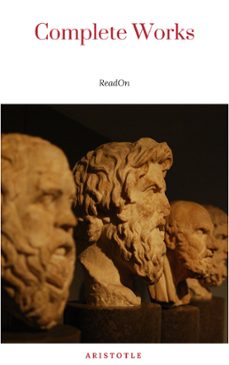
This ebook contains Aristotles complete works.This edition has been professionally formatted and contains several tables of contents. The first table of contents (at the very beginning of the ebook) lists the titles of all novels included in this volume. By clicking on one of those titles you will be redirected to the beginning of that work, where youll find a new TOC that lists all the chapters and sub-chapters of that specific work.Part 1 Logic (Organon)Part 2 Universal PhysicsPart 3 Human PhysicsPart 4 Animal PhysicsPart 5 MetaphysicsPart 6 Ethics and PoliticsPart 7 Aesthetic WritingsAristotlewas a Greekphilosopherandpolymathduring theClassical periodinAncient Greece. He was the founder of theLyceumand thePeripatetic schoolof philosophy andAristoteliantradition. Along with his teacherPlato, he has been called the "Father ofWestern Philosophy". His writings cover many subjects includingphysics,biology,zoology,metaphysics,logic, ethics,aesthetics,poetry, theatre, music,rhetoric,psychology,linguistics,economics,politicsand government. Aristotle provided a complex synthesis of the various philosophies existing prior to him, and it was above all from his teachings that the West inherited its intellectuallexicon, as well as problems and methods of inquiry. As a result, his philosophy has exerted a unique influence on almost every form of knowledge in the West and it continues to be a subject of contemporary philosophical discussion.Little is known about his life. Aristotle was born in the city ofStagirainNorthern Greece. His father,Nicomachus, died when Aristotle was a child, and he was brought up by a guardian. At seventeen or eighteen years of age, he joinedPlatos AcademyinAthensand remained there until the age of thirty-seven Shortly after Plato died, Aristotle left Athens and, at the request ofPhilip II of Macedon, tutoredAlexander the Greatbeginning in 343 BC.He established a library in the Lyceum which helped him to produce many of his hundreds of books onpapyrusscrolls. Though Aristotle wrote many elegant treatises and dialogues for publication, only around a third of his original output has survived, none of it intended for publication.Aristotles views onphysical scienceprofoundly shaped medieval scholarship. Their influence extended fromLate Antiquityand theEarly Middle Agesinto theRenaissance, and were not replaced systematically untilthe Enlightenmentand theories such asclassical mechanics. Some of Aristotles zoological observations found inhis biology, such as on thehectocotyl (reproductive) armof theoctopus, were disbelieved until the 19th century. His works contain the earliest known formal study of logic, studied by medieval scholars such asPeter AbelardandJohn Buridan. Aristotles influence on logic also continued well into the 19th century.He influencedIslamic thoughtduring theMiddle Ages, as well asChristian theology, especially theNeoplatonismof theEarly Churchand thescholastictradition of theCatholic Church. Aristotle was revered among medieval Muslim scholars as "The First Teacher" and among medieval Christians likeThomas Aquinasas simply "The Philosopher". His ethics, though always influential, gained renewed interest with the modern advent ofvirtue ethics, such as in the thinking ofAlasdair MacIntyreandPhilippa Foot.
Ver más