Architecture needs mechanisms that allow it to become connected to culture. It achieves this by continually capturing the forces that shape society as material to work with. Architecture's materiality is therefore a composite one, made up of visible forces (structural, functional, physical) as well as invisible forces (cultural, political, temporal). Architecture progresses through new concepts that connect with these forces, manifesting itself in new aesthetic compositions and affects. Ornament is the by-product of this process, through which architectural material is organized to transmit unique affects. This book is a graphic guide to ornaments in the twentieth century. It unveils the function of ornament as the agent for specific affects, dismantling the idea that ornament is applied to buildings as a discrete or non-essential entity. Each case operates through greater or lesser depth to exploit specific synergies between the exterior and the interior, constructing an internal order between ornament and material. These internal orders produce expressions that are contemporary, yet whose affects are resilient in time.
Form follows function. There has never been a more seductive dictum in the history of architecture. In The Function of Form, internationally acclaimed architect Farshid Moussavi provides a provocative critique of the historically opposing relationship between function and form to reveal the contradiction at the heart of modernism. We need to move away from the defunition of function as utility, she argues, to align it with how function is defined in mathematics, biology or music. Form, on the other hand, should be considered not only in the way buildings are produced, but also how they perform sensorially.
Farshid Moussavi , Daniel Lopez , Garrick Ambrose , Ben Fortunato , Ryan Ludwig , Ahmadreza Schricker In The Function of Form, internationally acclaimed architect, Farshid Moussavi, provides a provocative critique of the historically opposing relationship between function and form to reveal the contradiction at the heart of modernism. We need to move away from the definition of function as utility, she argues, to align it with how function is defined in mathematics, biology or music. Form, on the other hand, should be considered not only in the way buildings are produced, but also how they perform sensorially. Function and form, considered together in architecture, stand in opposition to the dualism which defined our approach to the built environment throughout the twentieth century. This book provides a thought-provoking account of the challenges facing the 21st century built environment, and an enlivened awareness of the wider possibilities of architectural form.
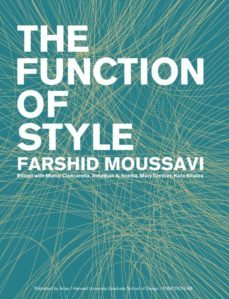
What is the function of style today? If the 1970s were defined by Postmodernism and the 1980s by Deconstruction, how do we characterize the architecture of the 1990s to the present? Some built forms transmit affects of curvilinearity, others of crystallinity; some transmit multiplicity, others unity; some transmit cellularity, others openness; some transmit dematerialization, others weight. Does this immense diversity reflect a lack of common purpose? In this book, acclaimed architect and theorist Farshid Moussavi argues that this diversity should not be mistaken for an eclecticism that is driven by external forces.