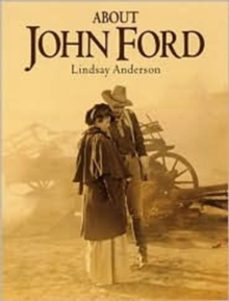
The career of John Ford considered by some to be America s greatest film director spanned nearly half a century With masterpieces like Stagecoach The Informer The Grapes of Wrath and The Searchers he was one of the world s most popular filmmakers and one of the most universally admired About John Ford is a critical interpretation and a personal tribute Lindsay Anderson s comprehensive survey of Ford s work has the authority of a writer who was himself a distinguished filmmaker and the portrait that emerges has the vividness and warmth of friendship About John Ford leaves no room for challenge David Robinson The Times London
Anderson served as third officer aboard the Eamont. Eamont was an opium clipper built in Cowes. Eamont was involved in the opening of Japan to foreigners in 1858, serving as a dispatch boat between Nagasaki and Shanghai, and was one of the first vessels to open up a trade with Formosa. The Eamont was employed in the negotiations for the first commercial treaty with Japan. On this occasion she ran into Nagasaki and quietly dropped anchor, in spite of the fact that opposition to the proposed commercial treaty was very strong at the time. On the following morning 150 boat-loads of Japanese attempted to tow her to sea, being evidently ignorant of an anchors raison detre. But though they attempted several similar methods to get rid of her they refrained from any armed attack, and, eventually, her mission was completely successful. This was in 1858, and the Eamonts crew saw many wonderful sights in that tierra incognita. The September Typhoon of 1858 destroyed several well-known opium clippers at Double Island, including the Anonyma, Gazelle, Pantaloon, and Mazeppa. Eamont was anchored off Double Island, with "150 fathoms of chain out and a second anchor backed on it at 60 fathoms." The waves in the anchorage were estimated to be as large as 40 feet, and the Eamonts crew had to cut away her masts. Eamont was one of only two ships in that anchorage to survive the night, the other being the Hazard. )
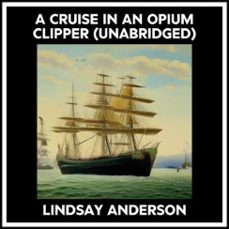
Eamont was an opium clipper built in Cowes. It was the subject of an 1891 book, A cruise in an opium clipper, by Captain Lindsay Anderson. Eamont was involved in the opening of Japan to foreigners in 1858, serving as a dispatch boat between Nagasaki and Shanghai, and was one of the first vessels to open up a trade with Formosa. The Eamont was sent on some very dangerous trips. She was one of the first vessels to open up a trade with Formosa, and made the first survey of the port of Taku, which she entered by bumping over the reef in spite of a tremendous surf beating upon it at the time, a most daring performance. And in her efforts to trade with the Formosans she had to withstand the attack of hundreds of armed natives right on top of a typhoon, which she succeeded in riding out on her moorings. But the captain of the Eamont was a famous fighting man, as the Chinese pirates knew to their cost. The Eamont was also employed in the negotiations for the first commercial treaty with Japan. )
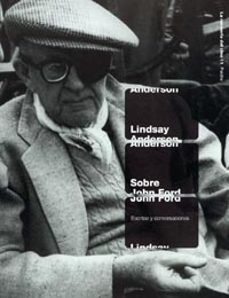
Sobre John Ford es a la vez una interpretación crítica y un tributo personal. Estudio exhaustivo de la obra de Ford, no sólo posee la autoridad de un autor que fue también un distinguido director de cine, sino que el retrato que emerge de sus paginas posee, consecuentemente, la viveza y el calor de la amistad. El resultado es este libro, no una hagiografia sino el relato de los encuentros que Anderson mantuvo con Ford, en el que se incluyen textos criticos clave, que nunca antes se habian publicado en forma de libro, asi como una valoracion de sus mayores logros artisticos. El libro se completa con una reveladora serie de cartas de los principales colaboradores de Ford en la elaboracion de sus guiones (Dudley Nichols, Frank Nugent y Nunnally Johnson) y conversaciones con cuatro actores que tuvieron la oportunidad de trabajar con el y conocerlo a fondo (Henry Fonda, Harry Carey Jr., Robert Montgomery y Donal Donnelly).La carrera de John Ford, uno de los mas importantes directores del cine clasico americano, abarca aproximadamente medio siglo. Obras maestras como El caballo de hierro (1924), El delator (1935), La diligencia (1936), Las uvas de la ira (1940) o Centauros del desierto (1956) lo han convertido en uno de los cineastas mas populares del mundo y en uno de los mas universalmente admirados.