
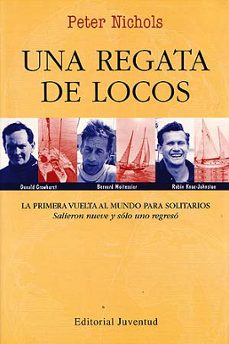

Diez meses antes de la llegada del hombre a la Luna, nueve hombres muy diferentes entre sí habían salido en barcos pequeños y mal equipados, decididos a hacer lo que hasta entonces nadie había conseguido: dar la vuelta al mundo sin escalas y sin ayuda externa. Solo uno de los nueve conseguiria llegar y obtener fama, riqueza y gloria. Para el resto de participantes la aventura de la Golden Globe les recompensaria con la desesperacion, la locura y la muerte.Aunque esta regata fue la fuente de inspiracion para la Vendee Globe y The Race, sus participantes tenian mas en comun con el capitan Cook y Magallanes porque entonces no habia alta tecnologia de navegacion; sobrevivian con sus ingenios y su ingenuidad, navegando al lado del sextante, el sol y las estrellas. Su tecnologia mas sofisticada, cuando funcionaba, era una radio.Una regata de locos es una increible historia de nueve aventureros, nueve personajes dispares, heroicos, desesperados y tragicos, en plena lucha contra el mar, soportando los mas fuertes temporales, la soledad mas inimaginable, las aguas mas traidoras, y debiendo tomar decisiones correctas en esos momentos en que un error puede significar la diferencia entre la vida y la muerte.
Set on the island of Mallorca, The Rocks is a double love story told in reverse. Opening in 2005 with a dramatic event that seems to seal the mystery of two lives, the story moves backwards in time, unravelling over sixty years, amid the olive groves and bars, the boats and poolside parties, the lives and relationships of two intertwined families within an expat community of endearing and flawed characters. As one story is revealed, another, sweeter one, a love story of a couple from the younger generation, arises in the wake of their elders' failures. The Rocks is a darkly comic, bittersweet, finally heartbreaking novel, that slips back in time to reveal the shocking incident that marked and altered these lives for ever.
The playwright Peter Nichols was a compulsive diarist all his life. He wrote for himself alone, responding to an urge to record the daily doings, private and professional, of his family, his fellows - and himself. The resulting diaries are candid, insightful, and often as shockingly funny as his plays.This selection, republished to mark the playwrights 90th birthday, covers the extraordinarily fruitful period between his first real hit, A Day in the Death of Joe Egg, to the stirrings of his masterpiece, Passion Play.As the seventies dawn, Peter Nichols is watching Joe Egg being filmed - and hating it. His next play, The National Health, is doing good box office for Oliviers National Theatre - but Olivier is hating it. And Forget-Me-Not Lane is shortly to open at the new Greenwich Theatre amid much anxiety. And then there are three small children (and a fourth in long-term hospital) to cope with, an extended family and the renovation of a tumbledown barn in rural France.What emerges is one of the most revealing and hilarious accounts of a writers life, and how whatever success comes along everyday life will keep getting in the way. As Nichols attempts to negotiate the world he has found himself in a world populated by the likes of Albert Finney, Kenneth Tynan, Stephen Sondheim, Michael Frayn and John Osborne he finds that he is never free from having to entertain his in-laws or cope with children vomiting in the back seat.NicholsDiaries are a brilliantly funny, acerbic study of theatrical life, a warts-and-all portrait of parenthood, and a fascinating companion to that remarkable decade, the Seventies.Sometimes he says terrible things that strike home to ones heartMichael Frayn
A comienzos del siglo XIX, el Beagle zarpó rumbo a Tierra del Fuego, una zona de mares increiblemente peligrosos. Su capitán, Robert Fitzroy, llevaba como pasajero nada menos que a Charles Darwin. Peter Nichols narra con autentica maestria ese viaje insolito, y entreteje la vida de estos dos singulares personajes antagonicos. Darwin y Fitzroy representaban mundos contrapuestos y su enfrentamiento anuncia la revolucion que habria de producirse en la concepcion que hoy tenemos del hombre, su origen y su destino.