El inglés William Stanley Jevons (1835-1882) es una de las figuras más destacadas de la historia del pensamiento económico. Nacido en Liverpool, empezó sus estudios en el University College de Londres, pero no los completó y marchó a Australia en 1852, como contrastador de la Casa de la Moneda de Sydney. Su interés se fue desplazando de la química y la meteorología hacia la economía, que estudió a su regreso a Londres, graduándose con honores en 1862. Catedrático de Economía en Manchester y Londres, autor de interesantes trabajos estadísticos, su obra más famosa es La Teoría de la Economía Política, publicada en 1871.
Recibe novedades de WILLIAM STANLEY JEVONS directamente en tu email

In "Political Economy," William Stanley Jevons presents a pioneering examination of economic theory through the lens of utilitarianism and marginalism. Written in the late 19th century, this work occupies a crucial position within the context of classical economics and the emerging neoclassical paradigm. Jevons employs a clear and systematic literary style, combining rigorous mathematical analysis with accessible prose, making complex concepts understandable for a broader audience. He introduces the notion of utility as central to decision-making processes, which reflects the evolving dialogue on the value of commodities and human behavior in market dynamics. William Stanley Jevons, an influential British economist and logician, laid the groundwork for modern economic thought. His keen interest in the principles of utility and efficient resource allocation can be traced back to his scientific background and involvement in the study of logic. Jevonss commitment to empirical observation and his dissatisfaction with prior economic theories propelled him to advance these ideas, culminating in this seminal text that challenges traditional views on value and exchange. For anyone interested in understanding the foundations of economic theory and its practical implications, Jevonss "Political Economy" is an essential read. It not only serves as an intellectual milestone in the evolution of economics but also encourages readers to contemplate the broader societal impacts of economic decisions. This work is invaluable for students, scholars, and practitioners seeking to deepen their comprehension of economic principles and their relevance in contemporary discourse.
In Political Economy by William Stanley Jevons, readers are introduced to a comprehensive study of economics as it was understood in the 19th century. Jevons delves into the principles of economics, discussing topics such as supply and demand, utility, and the theory of exchange. His writing is characterized by a clear and logical presentation, making complex economic concepts accessible to a wide audience. This book stands as a seminal work in the field of political economy, influencing future economists and policymakers. Jevons work reflects the intellectual climate of his time, combining classical economic theories with emerging ideas in the field. His insights offer valuable perspectives on the development of economic thought and remain relevant in contemporary economic discourse. Readers interested in the history of economics and the foundational principles of the field will find Political Economy a stimulating and enlightening read.
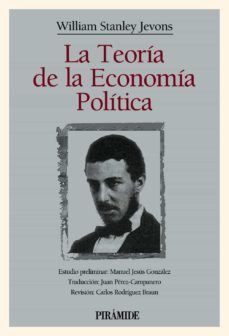
Nunca antes traducida al castellano, La Teoría de la Economía Política, de William Stanley Jevons, de 1871, marca un hito en el desarrollo del pensamiento económico. Es una de las tres obras que, junto con los Elementos del frances Leon Walras y los Principios del austriaco Carl Menger, resumen la llamada Revolucion Marginal, que en la decada de 1870 sento las bases de la economia moderna. Con su enfasis en la utilidad marginal y el empleo de instrumentos matematicos y geometricos, Jevons presenta en este volumen importantes aportaciones a la teoria del valor, del intercambio, del mercado de trabajo y del capital. En claro contraste con los clasicos, Jevons afirma que el problema central de la ciencia economica no es el crecimiento de la riqueza o su distribucion, sino la asignacion optima de los recursos. Todos los aspectos analiticos que en el futuro iban a conformar la economia neoclasica del siglo xx estan virtualmente planteados en La Teoria de la Economia Politica de William Stanley Jevons.
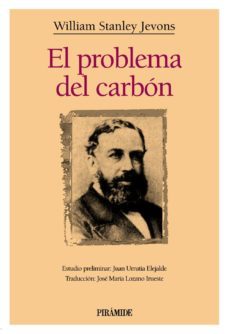
El problema del carbón (1865) es la obra que proporcionó a William Stanley Jevons todo el reconocimiento social del que gozó en su vida. Generalmente citado como un precedente teórico de la explotacion optima de recursos naturales no renovables, constituye tambien un intento de elevarse a la altura de los clasicos, de la amplitud de su mirada y de su ambicion por entender el devenir de una sociedad. Es la obra de un economista que no solo fue un gran teorico, sino tambien un ciudadano ejemplar que se preocupo por el crecimiento material, intelectual y moral de su propio pais.
El Estado y los trabajadores es la última obra de William Stanley Jevons (1835-1882), que, como buena parte de sus investigaciones, constituye un trabajo de síntesis, ruptura y crítica. Un estudio escrito en una epoca de capitalismo triunfante y reticente a la intervencion del Estado en la actividad economica. Jevons, defensor confeso de la Economia liberal, aposto en El Estado y los trabajadores por una cierta intervencion estatal en el mundo laboral y se atrevio a plantear aqui las contradicciones del discurso liberal. Considerado el padre del marginalismo economico, en este pequeño tratado nos muestra no solo un fresco impagable de la realidad laboral de la autocomplaciente Inglaterra victoriana, sino tambien un conjunto exhaustivo de soluciones para evitar el temido conflicto capital-trabajo
In The Principles of Science: A Treatise on Logic and Scientific Method, William Stanley Jevons presents a comprehensive exploration of the foundations of scientific reasoning and inquiry. This seminal work, characterized by its analytic clarity and rigorous argumentation, delves into the interplay between logic, mathematics, and empirical evidence. Jevons meticulously outlines the principles of inductive reasoning and the scientific method, underscoring the importance of systematic observation and experiment in the pursuit of knowledge. Through a meticulous examination of various scientific disciplines, he asserts the necessity of a cohesive methodology that transcends the boundaries of individual sciences, positioning his treatise within the burgeoning Victorian scientific movement. William Stanley Jevons (1835-1882) was a British economist and logician whose influence extended beyond economics into the realms of philosophy and science. His role in the development of logic and quantitative methods, as well as his advocacy for scientific approaches in economics, provided the impetus for this major work. Jevons was deeply engaged with the intellectual currents of his time, particularly the rise of empirical science, which shaped his reflections on the nature and processes of scientific thought. I highly recommend The Principles of Science to scholars and students alike who wish to grasp the intricacies of scientific inquiry and the logical frameworks underlying it. Jevonss insights continue to resonate in contemporary discussions about the epistemology of science and the nature of logic, making this treatise not only historically significant but also relevant for anyone aspiring to understand the foundations of scientific knowledge.