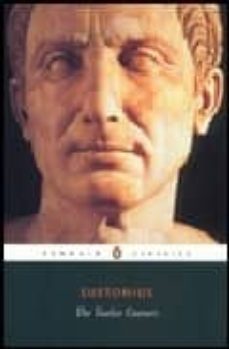
''Twenty-three dagger thrusts went home as he stood there. Caesar did not utter a sound...''.This vivid, racy account of the men who wielded absolute power over ancient Rome - including maniacs, tyrants, warriors, sadists and murderers - is the source for nearly everything we know about one of the most dramatic periods in history.Ten new titles in the colourful, small-format, portable new Pocket Penguins series.
The Twelve Ceasars of Suetonius, covering the Roman rulers from Julius Caesar to Domitian, remains one of the richest and most fascinating of all Latin histories. Suetonius gathered much of his information from eyewitnesses, checking his facts carefully and quoting conflicting evidence without bias. But his history is also the most vivid and raciest account we have of scandalous and amusing incidents in the domestic lives of the first Ceasars.
Written by the great Roman historian Suetonius in the year 121, "The Twelve Caesars" is an extremely important historical document and one of the main sources of knowledge about Roman history. In this magnificent work, which covers the period from the rise to the fall of the Roman Empire, we get to know the intimacy of the life of each of the twelve Caesars: their ancestors, their military campaigns, the events that led them to power and death, as well as the character and personality of each of them. Beyond historical facts, Suetonius managed to portray the human character of the 12 Caesars in an environment characterized by unlimited power, violence, and the debauchery and luxury of the emperors in ancient Rome. It is an exceptional work that deserves to be read.
Please note: This audiobook has been created using AI voice.Suetonius was a Roman historian born in about 69 AD, shortly after the death of the emperor Nero. This book, detailing the lives of the twelve Roman emperors who were known as Caesarsome by a family connection to Julius Caesar, some just as a titleis considered to be Suetonius most important work.The Lives of the Caesars is a detailed account of the often dramatic lives of these emperors, whose abilities and morals varied enormously; from the capable, stable Augustus, to the insane Caligula. Several of these men died violently either by their own hand or by assassins. Suetonius, though, is careful to give credit where it is due, outlining the better actions and laws of each alongside an account of the crimes and immoralities they also carried out.This turbulent period of Roman history has often been depicted in fiction and in media, drawing on the work of Suetonius and other contemporary historians. For example, Robert Graves novel I, Claudius (1934), which was made into a highlycontroversial television series by the BBC in 1976.