There are some events of which each circumstance and surrounding detail seems to be graven on the memory in such fashion that we cannot forget it, and so it is with the scene that I am about to describe. It rises as clearly before my mind at this moment as though it had happened but yesterday.It was in this very month something over twenty years ago that I, Ludwig Horace Holly, was sitting one night in my rooms at Cambridge, grinding away at some mathematical work, I forget what. I was to go up for my fellowship within a week, and was expected by my tutor and my college generally to distinguish myself. At last, wearied out, I flung my book down, and, going to the mantelpiece, took down a pipe and filled it. There was a candle burning on the mantelpiece, and a long, narrow glass at the back of it; and as I was in the act of lighting the pipe I caught sight of my own countenance in the glass, and paused to reflect. The lighted match burnt away till it scorched my fingers, forcing me to drop it; but still I stood and stared at myself in the glass, and reflected."Well," I said aloud, at last, "it is to be hoped that I shall be able to do something with the inside of my head, for I shall certainly never do anything by the help of the outside."
The January afternoon was passing into night, the air was cold and still, so still that not a single twig of the naked beech-trees stirred; on the grass of the meadows lay a thin white rime, half frost, half snow; the firs stood out blackly against a steel-hued sky, and over the tallest of them hung a single star. Past these bordering firs there ran a road, on which, in this evening of the opening of our story, a young man stood irresolute, glancing now to the right and now to the left.To his right were two stately gates of iron fantastically wrought, supported by stone pillars on whose summits stood griffins of black marble embracing coats of arms, and banners inscribed with the device Per ardua ad astra. Beyond these gates ran a broad carriage drive, lined on either side by a double row of such oaks as England alone can produce under the most favourable circumstances of soil, aided by the nurturing hand of man and three or four centuries of time.
December 23I have just buried my boy, my poor handsome boy of whom I was so proud, and my heart is broken. It is very hard having only one son to lose him thus, but Gods will be done. Who am I that I should complain? The great wheel of Fate rolls on like a Juggernaut, and crushes us all in turn, some soon, some lateit does not matter when, in the end, it crushes us all. We do not prostrate ourselves before it like the poor Indians; we fly hither and thitherwe cry for mercy; but it is of no use, the black Fate thunders on and in its season reduces us to powder.Poor Harry to go so soon! just when his life was opening to him. He was doing so well at the hospital, he had passed his last examination with honours, and I was proud of them, much prouder than he was, I think. And then he must needs go to that smallpox hospital. He wrote to me that he was not afraid of smallpox and wanted to gain the experience; and now the disease has killed him, and I, old and grey and withered, am left to mourn over him, without a chick or child to comfort me. I might have saved him, tooI have money enough for both of us, and much more than enoughKing Solomons Mines provided me with that; but I said, "No, let the boy earn his living, let him labour that he may enjoy rest." But the rest has come to him before the labour. Oh, my boy, my boy!I am like the man in the Bible who laid up much goods and builded barnsgoods for my boy and barns for him to store them in; and now his soul has been required of him, and I am left desolate. I would that it had been my soul and not my boys!
Sir Henry Rider Haggard, KBE (/?h??rd/; 22 June 1856 14 May 1925) known as H. Rider Haggard was an English writer of adventure novels set in exotic locations, predominantly Africa, and a pioneer of the Lost World literary genre.[1] He was also involved in agricultural reform throughout the British Empire. His stories, situated at the lighter end of Victorian literature, continue to be popular and influential (font: Wikipedia)
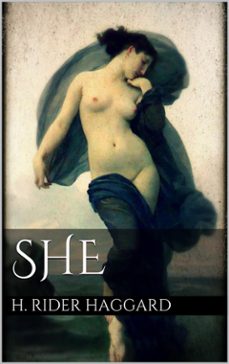
She subtitled A History of Adventure is a novel by H. Rider Haggard (18561925), first serialised in The Graphic magazine from October 1886 to January 1887. She is one of the classics of imaginative literature, and one of the best-selling books of all time, with over 100 million copies sold in 44 different languages as of 2013. She was extraordinarily popular upon its release and has never been out of print. According to literary historian Andrew M. Stauffer, "She has always been Rider Haggards most popular and influential novel, challenged only by King Solomons Mines in this regard".The story is a first-person narrative that follows the journey of Horace Holly and his ward Leo Vincey to a lost kingdom in the African interior. There they encounter a primitive race of natives and a mysterious white queen named Ayesha who reigns as the all-powerful "She", or "She-who-must-be-obeyed". In this work, Rider Haggard developed the conventions of the Lost World subgenre, which many later authors emulated.She is placed firmly in the imperialist literature of nineteenth-century England, and inspired by Rider Haggards experiences of South Africa and British colonialism. The story expresses numerous racial and evolutionary conceptions of the late Victorians, especially notions of degeneration and racial decline prominent during the fin de siecle. In the figure of She, the novel notably explored themes of female authority and feminine behaviour. It has received praise and criticism alike for its representation of womanhood.